Mount Ama Dablam Expedition
Price
$10,800.00$11,650.00
Destination
Everest Region
Duration
30 days
Difficulty
Expert
Activity
Mountaineering
Group Size
1 to 10 people in a agroup
Max Altitude
6812m/22349ft
Best Season
Mar to May & Sep to Nov
Accommodation
Tea Houses and tented camp at Base Camp
Meals
Package (as per the deal)
Start/End Point
Kathmandu / Kathmandu
Overview
Ama Dablam Expedition—an exhilarating Himalayan climb to 6812m, combining technical rock, snow and ice with spectacular Everest-region views. A serious challenge for experienced climbers.
Ama Dablam Expedition: A Technical Climb Through the Heart of the Khumbu
An expedition to Ama Dablam (6812m / 22349 ft) is much more than a high-altitude trek. It is a serious Himalayan climbing adventure that combines the gradual approach through Sherpa villages with sustained technical climbing on one of Nepal's most recognizable mountain ridges.
Ama Dablam rises above the Imja Valley in the Khumbu and is particularly distinctive because of its elegant pyramid-shaped summit, steep Southwest Ridge and the hanging glacier that gives the mountain its name and appearance. The standard climbing route follows the Southwest Ridge, taking climbers from Ama Dablam Base Camp through a series of exposed rock, mixed climbing and steep snow and ice sections before reaching the summit.
The approach: Lukla to Ama Dablam Base Camp
The expedition normally begins at Lukla, followed by the classic approach through the Sherpa settlements of the Khumbu. The trail passes through Phakding, Namche Bazaar, Tyangboche, Pangboche and the Imja Valley before turning away from the main Everest Base Camp trail toward Ama Dablam Base Camp.
The mountain scenery changes noticeably along this route.
From Namche Bazaar, the trail climbs above the Imja Khola valley and opens views of Thamserku and Kangtega, while Ama Dablam, Lhotse and Everest gradually become prominent on the skyline. Nepal Tourism Board specifically identifies this section as one of the places where these major peaks dominate the landscape of Upper Khumbu.
At Tyangboche (or Tengboche), approximately 3860 m, the famous Tyangboche Monastery stands on a ridge overlooking the surrounding valleys. The monastery is particularly notable for its setting beneath Ama Dablam, which forms the dramatic mountain backdrop. From here, the route continues through Pangboche along the Imja Khola valley.
The approach is therefore not simply a walk through attractive scenery. It provides a gradual introduction to the geography of the Khumbu: forested lower valleys give way to alpine meadows, glacial valleys and increasingly barren high-altitude terrain.
Sherpa culture along the expedition route
The approach also provides an opportunity to experience the culture of the Sherpa communities who have lived in the Khumbu for generations.
Namche Bazaar is the commercial centre of the upper Khumbu and an important acclimatization stop. The villages around Namche, including Khumjung and Khunde, provide opportunities to see traditional Sherpa settlements away from the main trading centre.
Further up the valley, Tyangboche also is one of the most important Buddhist religious centres in the region. The monastery occupies a spectacular ridge location with Ama Dablam forming its prominent mountain backdrop.
From Tyangboche, the trail passes through Pangboche, one of the oldest permanent settlements in the Upper Khumbu, before leaving the main Everest Base Camp route for Ama Dablam Base Camp.
Ama Dablam Base Camp - 4600m.
Ama Dablam Base Camp lies at approximately 4600m in the Mingbo Valley beneath the mountain. It is positioned on a relatively broad grassy area and provides an impressive perspective of Ama Dablam's Southwest Ridge.
From Base Camp, the mountain rises dramatically above. The view is not simply of a distant snow peak: the Southwest Ridge and the upper climbing route are visible as the mountain rises toward the summit.
From the Base Camp area, climbers can also see a number of surrounding Himalayan peaks, including Lhotse, Nuptse, Baruntse, Makalu, Thamserku, Cholatse and Taboche, depending on weather and visibility.
Base Camp also becomes the centre of expedition life. Equipment is checked, climbing skills are practised and repeated, weather forecasts are studied and acclimatization rotations are carried out before the summit attempt.
From Base Camp to the high camps
The climbing begins in earnest above Base Camp. Depending on the expedition's strategy and prevailed mountain conditions, an Advanced Base Camp or high camp around 5400 m may be established before Camp 1.
The terrain changes considerably above this point. The route involves large boulders, scrambling and increasingly exposed sections before reaching the Southwest Ridge. Camp 1 is generally established around 5800m.
The climb from Camp 1 to Camp 2 is where Ama Dablam begins to demonstrate its technical character.
Camp 1 to Camp 2: the exposed Southwest Ridge
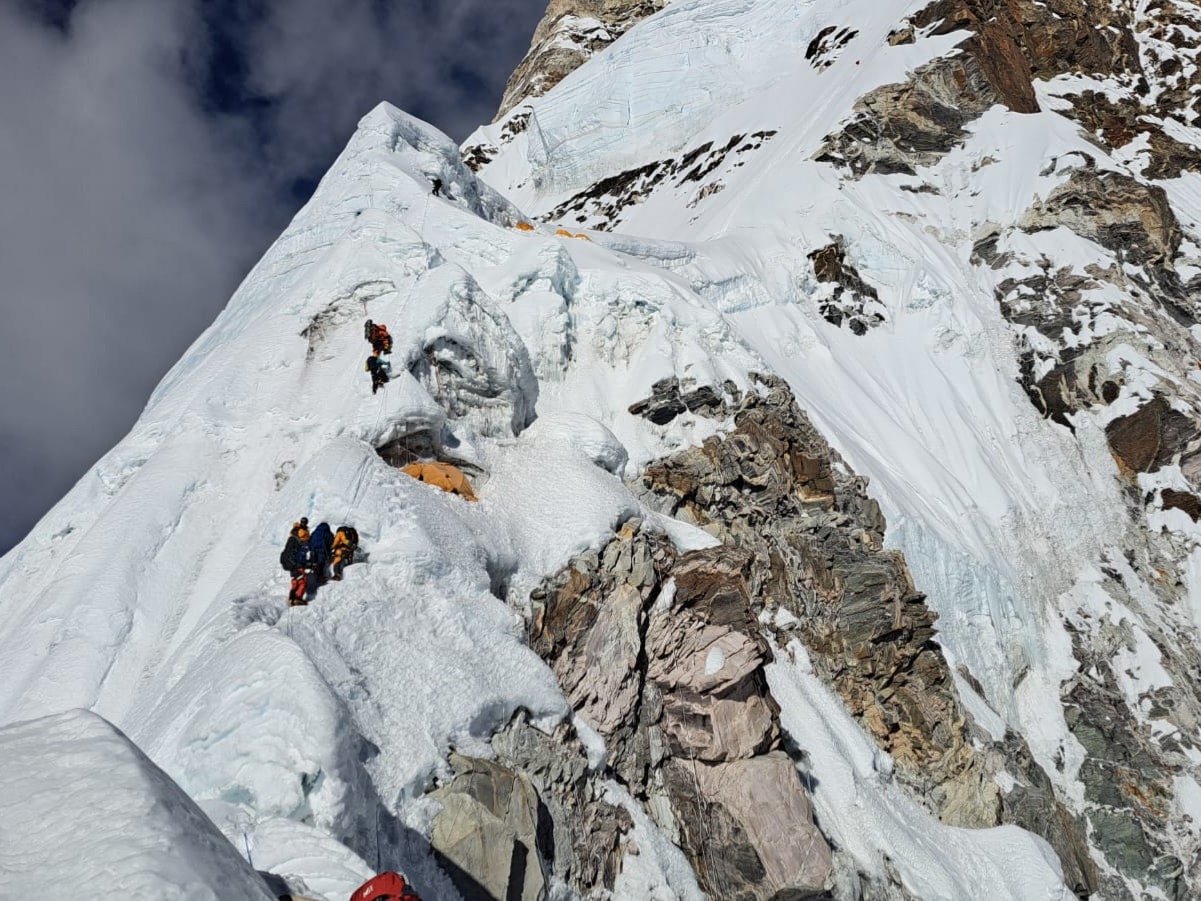
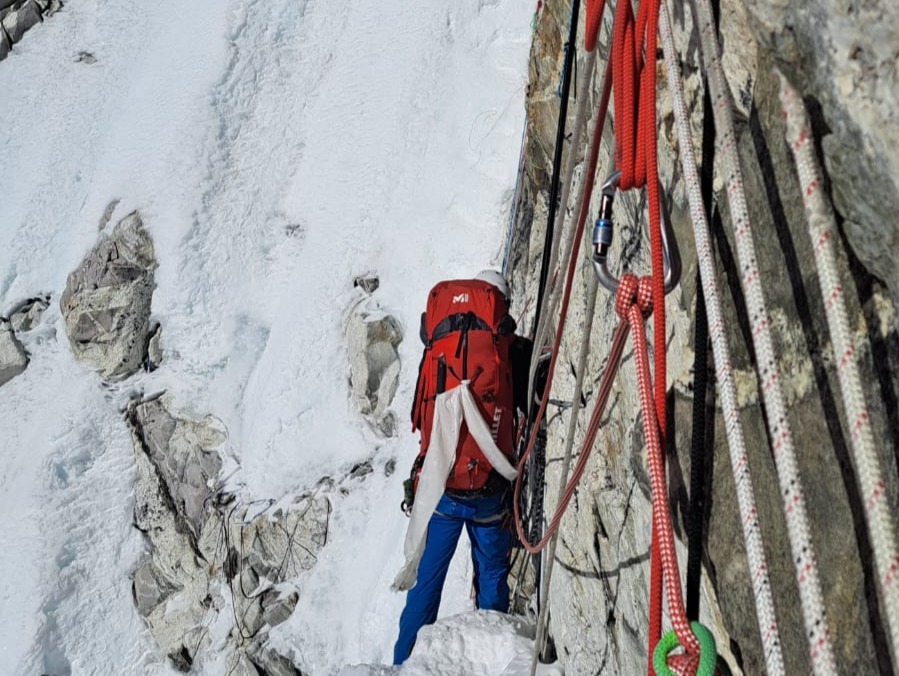
The section between Camp 1 and Camp 2 follows a narrow rocky ridge with significant exposure on both sides. Climbers negotiate rock slabs, pinnacles and steep sections using fixed ropes.
One of the best-known technical features is the Yellow Tower, a steep rock section encountered near Camp 2 around 6000 - 6100m.
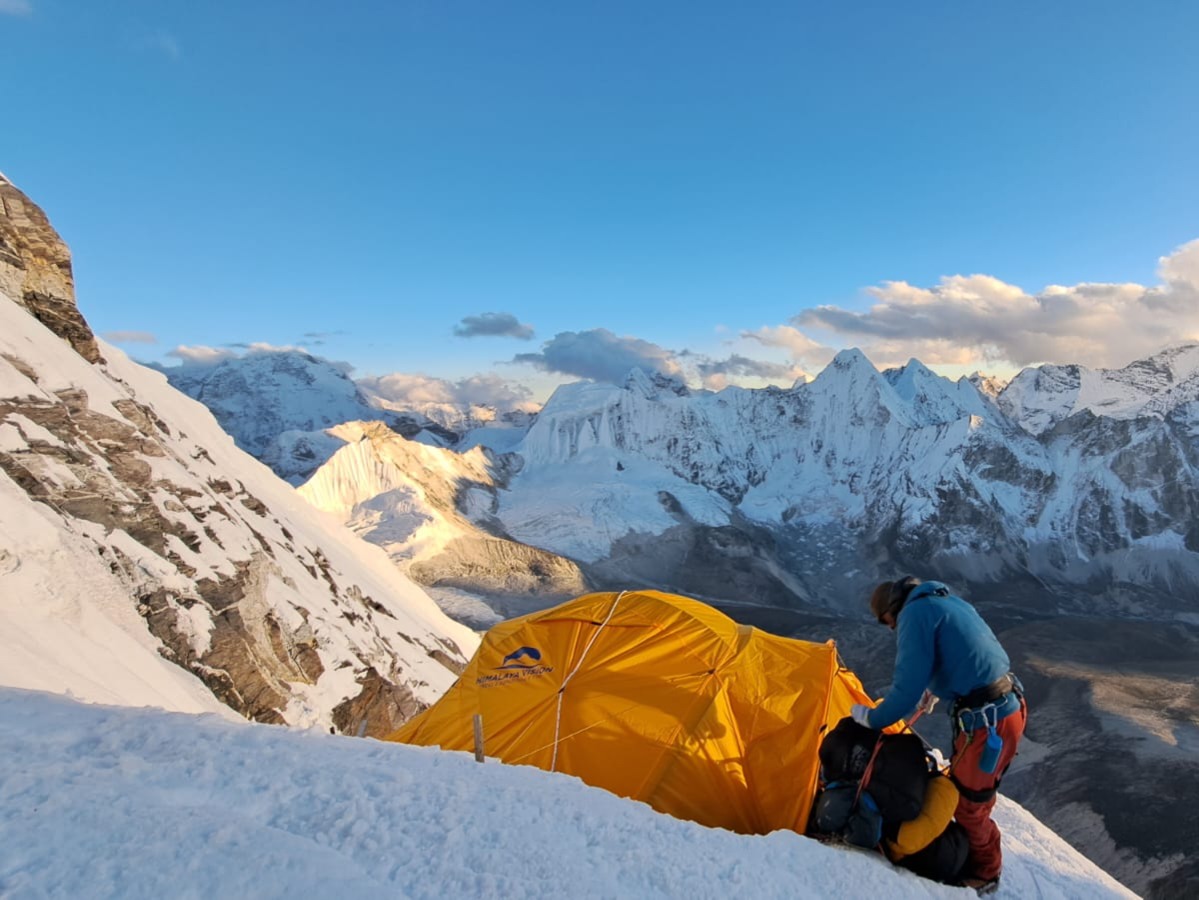
Camp 2 is one of the most spectacular positions on the mountain. The tents are placed on extremely limited rocky platforms on the ridge, with steep drop-offs on either side. From this elevation, the Khumbu landscape is far below, while Everest, Lhotse and Nuptse become prominent across the surrounding skyline.
This is also where the character of the expedition changes from trekking to genuine technical mountaineering. Efficient movement on fixed ropes, good rock-climbing technique and the ability to operate safely in exposed terrain are essential.
Camp 2 to Camp 3: Grey Tower and Mushroom Ridge
Above Camp 2, the route enters more serious mixed climbing terrain.
The climbers encounter steep snow and ice gullies leading toward the Grey Tower, followed by mixed rock-and-snow climbing and the distinctive Mushroom Ridge. This ridge is narrow, exposed and composed of snow and ice formations, making it one of the memorable sections of the entire climb.
Camp 3 is normally established around 6300 - 6400 m. It is an exposed position below the summit section and close to the large hanging glacier known as the Dablam.
At this altitude, the physical challenge is compounded by the thin atmosphere, cold, wind and exposure. Camp 3 is therefore not merely another overnight camp; it is the staging point for the final summit push.
Summit day - 6812m.
The final climb takes the route around the right side of the large hanging glacier before continuing up steep snow and mixed terrain toward the summit. The upper slopes can be steep, with some descriptions of the final climbing reaching approximately 40 - 60 degrees, depending on the particular section and route conditions.
Finally, the climber reaches the summit of Ama Dablam at 6812 m.
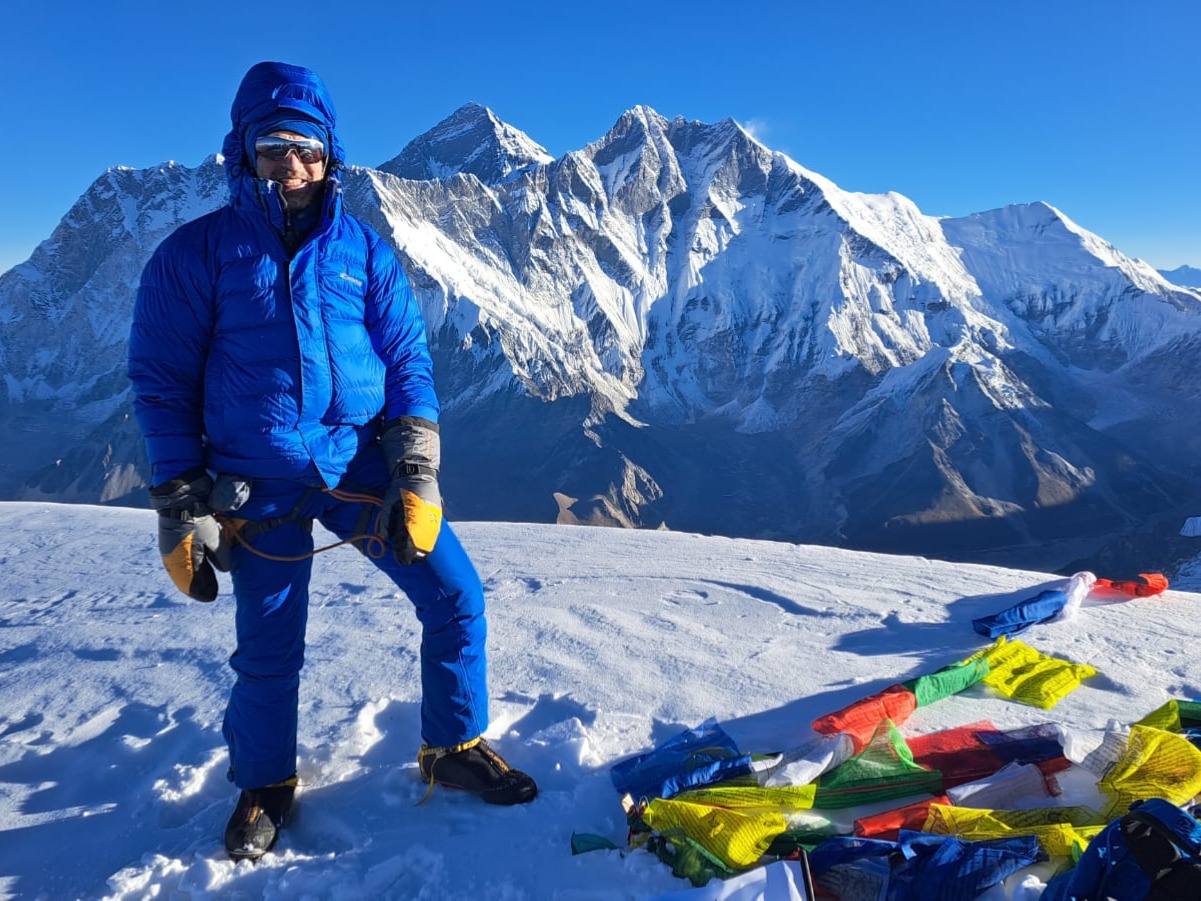
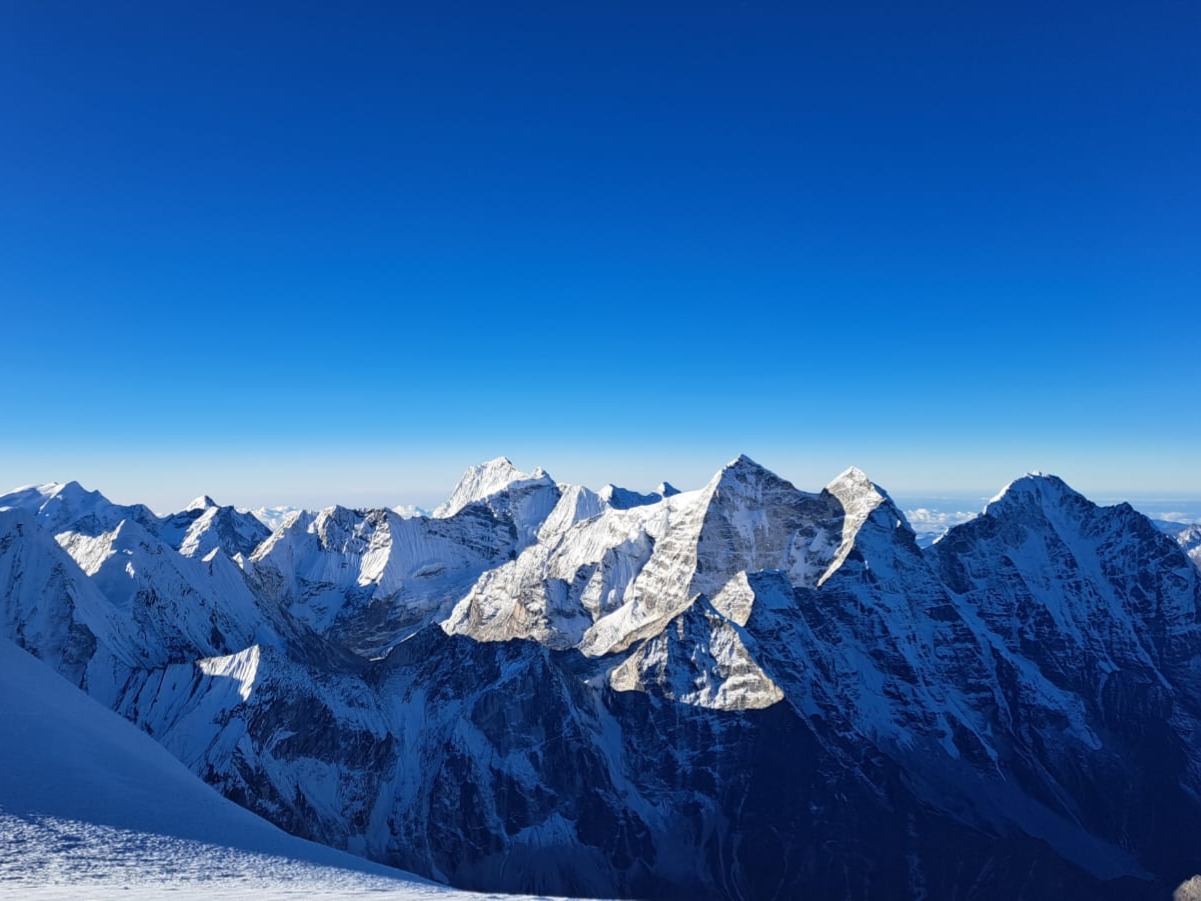
The reward is an exceptional panorama across the Khumbu and the wider Himalayan range. On a clear summit day, the view includes Mount Everest (8849 m), Lhotse (8516 m), Makalu (8485 m), Cho Oyu (8188 m) and other major Himalayan peaks. Five of the world's six highest mountains of the region can be seen from the summit.
Looking down, the deep valleys of the Khumbu appear dramatically far below, while the ridges and glaciers surrounding Ama Dablam reveal the scale of the mountain environment that is difficult to appreciate from the trekking trail.
Preparation is part of the expedition
An Ama Dablam expedition requires considerably more preparation than a normal high-altitude trek.
Physical preparation should focus on cardiovascular endurance, leg strength, core strength and the ability to work for long periods while carrying climbing equipment.
Technical preparation is equally important. Climbers should be comfortable with crampons, ice axe techniques, fixed-rope climbing, ascending and descending fixed ropes with a Jumar, abseiling/rappelling, movement on steep snow and ice and exposed rock scrambling. The Yellow Tower, mixed climbing sections and the upper snow and ice terrain make technical competence essential.
Acclimatization is another major component of the expedition. You should normally be making progressive rotations to higher elevations before attempting the summit. The exact schedule depends on individual acclimatization, weather, route conditions and the expedition leader's strategy.
The real attraction of Ama Dablam
What makes Ama Dablam special is the combination of everything involved in the journey.
You begin among the Sherpa villages and Buddhist monasteries of the Khumbu, walk beneath mountains such as Thamserku, Kangtega and Ama Dablam, establish Base Camp at approximately 4600 m, and then gradually leave the trekking world behind as the route climbs onto the exposed Southwest Ridge.
Above 5800 m, the expedition becomes a technical climb involving rock, snow and ice. The Yellow Tower, Grey Tower and Mushroom Ridge provide distinct climbing challenges before the final ascent to 6812 m.
At the summit, the reward is not simply a view of Ama Dablam itself. You are standing above the Khumbu with a panorama that can include Everest, Lhotse, Makalu, Cho Oyu and numerous other Himalayan peaks.
That combination of Sherpa culture, high-altitude trekking, technical rock and ice climbing, dramatic exposure and an exceptional Himalayan summit panorama is what makes an Ama Dablam expedition one of Nepal's most sought-after mountaineering adventures.
Itinerary
Arrival in Kathmandu International Airport; reception and transfer to hotel. Most probably your hotel will be in Thamel, that is about 4km away from airport and takes about 20min when the traffic is not bad. Upon reaching hotel, room check is followed by welcome drinks and briefing about today’s activities. Probably, today being the first day in Kathmandu after a long flight from home, it’s good to have a rest for some time and then go for rambling by your hotel area.
Later in the evening you’re invited to the welcome dinner from the side of Alpine Exodus in which your expedition guide/s, assistant/s, and available number of supporting staffs are joined too. We will introduce each other with the staff as well. Return to hotel and good night by 8:30 – 9pm.
Inclusions & Exclusions
What's Included
- Certified Climbing Guide & assistant (so the ratio of guide/client will be 2:1. Additional guide/s can be arranged, but applies extra charges),
- Base camp arrangement with a team of Cook and kitchen helpers (Helpers increase with the number of climbing team members),
- Hotel accommodation in Kathmandu as the program with breakfast including basis. (Should clients return early from their expedition, clients will be responsible for their extra Kathmandu hotel bookings)
- Amadablam Peak climbing permit,
- All trekking permits and entry tickets (Sagarmatha Region Permit and TIMS)
- All internal-local transportation including Kathmandu to Manthali transfer (depends on what month the trip falls, most probably all the high season flights take place from Manthali),
- Expedition tents (2 men tents). Local make tents for base camp, these are warmer, cozier and stronger. For higher camps Brands Salewa, Mountain Hardwear, Samaya equipment, Kailas etc.
- 40 kgs personal weight (Extra additional weight, clients will need to hire an additional porter, estimated $800 USD for a porter. Similarly, on the flight to Lukla after anything 15kg (this is the allowed weight on this flight) per passenger will cost US$ 2.5 for every kg. This is additional too).
- Chocolate, energy bars, hydration pills, biscuits, canned foods, etc.
- Burners and expedition equipment,
- 1 bottle of oxygen (for emergency use only),
- Breakfast, Lunch, and Dinner on trek and expedition days,
- Lodge accommodation during the trek,
- A porter per two guests on trek (the expedition porters may not follow the Gokyo loop trail. They head directly to ABC from Namche),
- Kathmandu (or Manthali) to Lukla and return flight tickets,
- Arrival pick-up and departure,
- Basic First aid kit
- Welcome/Farewell Dinner
What's Not Included
- Visas and travel insurance, international airtickets,
- Entertainment and food (in Kathmandu),
- Bottled drinks and beverages,
- Evacuation (will be done in your account),
- Summit Tips ($800 USD),
- Single supplement Charges,
- Laundry, Phone services, Personal expenditure transactions,
- Walkie-talkie/ Satellite phone,
- Gamov Bag (also called APC chamber we suggest to have one),
- Optional trips,
- Tea breaks, chocolates or other snacks, and any meals besides breakfast, lunch, and dinner.
- Delay and cancellation because of natural phenomenon,
- International flights to Kathmandu,
Frequently Asked Questions
Previous high altitude climb of at least 1 X 6000M and several technical peaks of with alpine/mountaineering climbing experiences are absolutely necessary in order to climb Amadablam peak.
Climbers need to have good knowledge and experience of hiking/climbing using crampons on snow, ice and steep surfaces. Be comfortable in using a fixed rope to climb on steep and exposed sections, traversing on mountain slopes and climbing through spurs on the routes. Climbers must be knowledgeable with the use of climbing gears, basic rope techniques like tying safety knots, and abseiling when coming down from the mountains. And importantly the clients have the mentally and strongly prepared to climb in cold and windy conditions.