Thunder Dragon Land; Pristine Nature & Culture
Price
$2,408.00$2,500.00
Destination
Bhutan Tours
Duration
9 Nights / 10 Days
Difficulty
Easy
Activity
Tours
Group Size
2 to 16 people
Max Altitude
2600m/8530ft
Best Season
Sep to Nov and Mar to May
Accommodation
Hotels
Meals
Package (as per the deal)
Start/End Point
Kathmandu - Paro / Paro - Kathmandu
Overview
Arrival day in Kathmandu: Airport reception and transfer to Hotel Radisson. At the Hotel after room check-in a short briefing about the trip.
Bhutan, traditionally known as Druk Yul - the Land of the Thunder Dragon, is a Himalayan kingdom where spectacular mountain landscapes and deeply rooted Buddhist culture remain an integral part of everyday life. This journey across Bhutan takes you far beyond the familiar sights of Paro and Thimphu, travelling through historic valleys, mountain passes, ancient fortresses and remote central Bhutan before reaching the spiritual heartland of Bumthang.
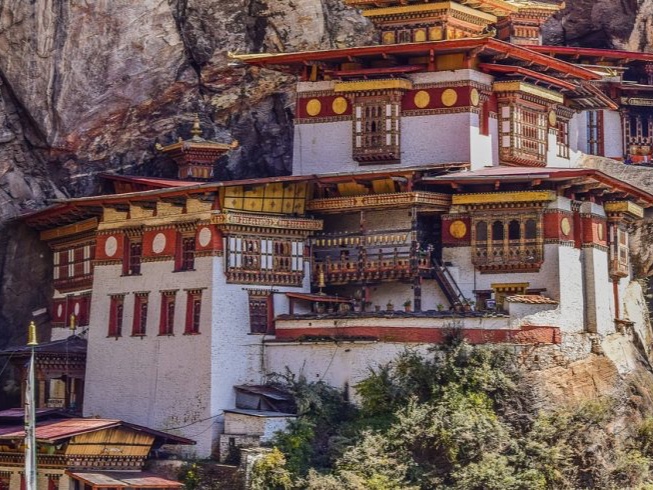
The journey begins in Paro flying in from Kathmandu, one of Bhutan's most beautiful valleys and the country's gateway for international visitors. Surrounded by forested mountains and traditional Bhutanese houses, Paro is home to important cultural landmarks including Rinpung Dzong and the legendary Taktsang (Tiger's Nest) Monastery, dramatically perched on a cliff above the valley. The hike to Taktsang provides one of Bhutan's most memorable experiences, combining pine forests, mountain scenery and one of the country's most sacred Buddhist sites.
From Paro, the journey continues to Thimphu, Bhutan's capital, where traditional architecture, Buddhist heritage and modern Bhutanese life exist side by side. Rather than a conventional capital city dominated by high-rise buildings, Thimphu retains its distinctive Bhutanese character. The city provides opportunities to visit the Memorial Chorten, Buddha Dordenma, Tashichho Dzong and traditional arts and craft centres while observing the daily life of the Bhutanese people.
Leaving western Bhutan behind, the road crosses the spectacular Dochula Pass, at approximately 3,100 metres, where the famous 108 Druk Wangyal Chortens stand against a backdrop of Himalayan peaks on clear days. The descent from the pass leads into the warmer Wangdue Phodrang region, where the landscape changes from high mountain terrain to deep river valleys, agricultural land and subtropical vegetation.
The journey then moves deeper into central Bhutan, crossing the Black Mountains and entering the historic district of Trongsa. Strategically positioned above the Mangde Chhu valley, Trongsa has long been an important link between western and central Bhutan. Its magnificent Trongsa Dzong, one of the largest and most impressive fortress-monasteries in Bhutan, stretches dramatically along the mountain ridge. The nearby Ta Dzong, once a watchtower, offers another perspective on the region's strategic history.
From Trongsa, the road continues through increasingly tranquil mountain country to Bumthang, often regarded as the spiritual heartland of Bhutan. Bumthang is not a single town but a group of four main valleys - Chokhor, Tang, Ura and Chhume - each with its own character, villages and religious heritage. The Chokhor Valley, in particular, contains some of Bhutan's most important temples and monasteries, including Jakar Dzong, Kurjey Lhakhang and Jambay Lhakhang.
Bumthang offers a different experience from western Bhutan. The valleys are broader and more pastoral, with fields, traditional farmhouses, apple orchards and small villages surrounded by forested hills. At places such as Jambay Lhakhang and Kurjey, the journey connects directly with Bhutan's centuries-old Buddhist traditions and the legends associated with Guru Padmasambhava, whose teachings played a central role in the establishment of Buddhism in Bhutan.
The return journey through Trongsa and Wangdue completes a remarkable cross-section of Bhutan's geography and culture. Along the way, the road itself becomes part of the experience - winding through high mountain passes, deep river gorges, pine and rhododendron forests and traditional settlements.
This is a journey for travellers who want to experience Bhutan beyond its postcard images. Paro reveals the country's iconic landscapes and sacred sites; Thimphu introduces its contemporary capital and national institutions; Wangdue and the mountain passes reveal the dramatic transition between western and central Bhutan; Trongsa brings the country's historic fortress culture to life; and Bumthang offers an intimate encounter with Bhutan's spiritual traditions, rural landscapes and timeless mountain communities.
Throughout the journey, Bhutan's distinctive identity remains visible - in the architecture of its dzongs and houses, the prayer flags fluttering above mountain passes, the monasteries and temples scattered through the valleys, and the traditional way of life that continues alongside the modern kingdom.
Paro - Thimphu - Dochula - Wangdue - Trongsa - Bumthang and back is therefore not simply a sightseeing circuit. It is a journey across the geographical and cultural heart of the Land of the Thunder Dragon, from its western gateway to its sacred central valleys.
Itinerary
The flight into the Himalayas reveals scenic and breathtaking views of Himalayan Mountains of the world. If weather permits you will be able to see Mt Everest (8848.86m/29032ft) and other Himalayan mountain ranges. Landing in the Paro valley, surrounded by 4000 meter high mountains stretching across the west of Bhutan, enables you to have a visual landing which is indispensable and that makes your day an unforgettable one.
Your Bhutanese representative will greet you on arrival and drive you through the beautiful valley of Paro to the hotel where you will be staying.
This beautiful valley is home to many Bhutan’s oldest monasteries and temples. The country’s only airport is in Paro. The valley is also home to Mount Chomolhari (7,300 meters) situated at the northern end of the valley whose glacier water forms the Pachu flowing through the valley.
Your flight will arrive in Paro at around 0940am from Bangkok.
Later visit, Ta Dzong: This means - watch tower, which it served as during the 17th century to guard the region from the Tibetan invasion. It was converted to the National Museum in 1968. It houses a fine collection of Bhutanese art, relics, religious thankas (used to bolster the visualization generated during meditation and were made from Himalayan animal fibers), paintings, animals found in Bhutan, arms and ammunitions and the country’s exquisite stamp collections.
Rimpung Dzong: Means fortress of the heap of jewels. It was built during the time of Zhabdrung (deeply revered to this day as dynamic political and spiritual leader) in 1644. It houses both administrative and monastic bodies. It is also the venue for the Paro festival (Tsechu), held once in a year during spring season (April). The main highlight of Paro festival is that it has the unfurling of the one of the oldest Thongdol (gigantic scroll painting) which literally means
Kichu Lhakhang(Monastery): It is one of the two most sacred and the oldest temples in Bhutan. It was built in 7th century by Tibetan King Songtsen Gampo. It is believed that he took the responsibility to built 108 temples in the different regions of Tibet, Bhutan and in other Himalayan regions to control evil spirits, disease and droughts out of which two of them are in Bhutan. (Kichu Lhakhang in Paro and Jambay Lhakhang in Bumthang).
Later stroll around the town ad see how locals live.
Overnight in Paro
Inclusions & Exclusions
What's Included
- Deluxe hotel accommodation with breakfast (twin sharing),
- All airport pick up and transfers,
- Airfare to and from Kathmandu (KTM) ~ Paro (PBH) both way,
- 1 welcome dinner.
- Airport pick up and transfers,
- Visa fee for Bhutan, SDF, Airfare of KTM ~ PBH (B/W)
- Hotel/accommodation at Aman Kora (in Thimpu, Punakha and Bumthang) and Hotel Uma (in Paro) with all meals. In other places the best available Hotels are offered with all meals as well (all are twin sharing).
- All drive and treks with necessary guide and assistances,
- Visit to textiles museums, textiles villages and hand loom development institute,
- A hike to Taktshang Monastery (Tiger’s nest),
- A visit to the weekend market in Thimphu (Fri-Sat-Sun),
- A “special welcome” meal on the first day,
- A “special farewell” meal on the penultimate evening,
- An optional evening visit to “down town Thimphu” to enjoy in the bars, discotheques and see the Bhutanese live performances,
- A traditional Bhutanese meal in a restaurant,
- A lunch meal and hot stone bath in a Bhutanese farmhouse,
- A visit to the famous sites such as fortresses, monasteries, arts and crafts school and museums.
What's Not Included
- Beverages,
- Your personal expenses,
- Tipping to Guide and Driver, etc.